A tape diagram is a pictorial model students can draw to represent a mathematical relationship or to develop understanding of a math concept. Tape diagrams are useful for solving many unlike types of math issues but are commonly used with give-and-take problems. Students tin use a tape diagram to organize information and communicate their mathematical thinking.
Start with tape diagrams early on.
Eureka Math ® introduces tape diagrams as early as Grade i with improver and subtraction to reinforce the part–whole human relationship. The use of tape diagrams supports students' transition from concrete models to representational and symbolic models. The following Grade 1 instance shows how to introduce students to using tape diagrams. Students can probable correspond vi + 7 by drawing dots. When you draw rectangles around the dots representing the addends and indicate the sum with a question marking, you lot've fabricated a tape diagram that reinforces the part–whole nature of the quantities. Students begin to realize how the 2 parts come together to brand a whole—the box gathers all the dots into one group; they practice not appear simply equally 13 discrete objects. This activity lays the foundation for the Grade ii example, in which they start to explore equal parts. Once students know how to draw record diagrams, they can use them to brand sense of many mathematical relationships.
| Course one: Addition | Grade 2: Making Equal Groups |
 |  |
Tape diagrams are useful at all grade levels.
When students encounter new challenges, the tape diagram tin be a familiar place to start. What in one case helped with basic whole number arithmetic in primary grades extends to fractions in intermediate grades and even algebra in middle and loftier school. Let's look at how students can utilise record diagrams to assist them make sense of those concepts.
Beginning, we'll see how students can use the tape diagram to understand operations with fractions in this example from Grade 5.
Ms. Hayes has ½ liter of juice. She distributes information technology equally to six students in her tutoring group. How many liters of juice does each student get?
| Detect how the tape diagram represents the problem. A larger rectangle represents a whole liter. That rectangle is partitioned to show half liters. And then each half liter is partitioned to represent the amount each student gets. The drawing makes pregnant of segmentation problems clear in a way that inverting and multiplying does not. | 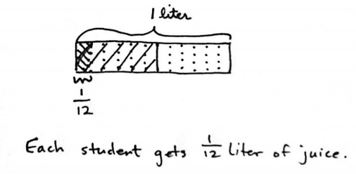 |
Next, allow's look at an example of an algebraic problem from Grade 7.
Jenny is on the local swim team for the summer and has swim exercise four days per week. The schedule is the same each mean solar day. The team swims in the morning and then once again for 2 hours in the evening. If Jenny swims 12 hours per week, how long does she swim each morning?
| In this case, the tape diagram shows the four days of practice, each with an unknown morning practice time, and ii hours of practise in the evening. Students can utilise a tape diagram to aid write an equation such as 4(x + 2) = 12. They may as well work backward, subtracting the eight hours inside the tape from the 12 full hours, and then dissever the 4 hours equally amidst the 4 sections to see that each represents ane hour. |  |
Finally, let's look at an Algebra I problem.
V years from now, the sum of the ages of a woman and her daughter will exist twoscore years. The departure in their present age is 24 years. How old is her girl at present?
| This is a skillful example of how a tape diagram helps students organize data. The first section of each record represents 5 years from now. The next department represents the girl's historic period now. The final section of the top tape shows the current age divergence, and both tapes together represent the full. Students employ this cartoon to write an equation to discover the sum of each section. For instance, five + x + 24 + 5 + x = 40 or 2x + 34 = forty. |  |
You can introduce students to tape diagrams at any time.
If your students are only beginning to use Eureka Math, yous may wonder how to innovate them to tape diagrams if they didn't use them in previous years. Consider doing i entire lesson on tape diagrams. During this lesson, use issues from previous grades to keep the focus on understanding record diagrams and non on learning a new math concept. You'll be surprised how quickly students understand the model. In fact, students unremarkably embrace it more quickly than teachers, probably because they have fewer years of doing things differently to overcome.
Another suggestion is to scaffold the first problems that students stand for with tape diagrams. For example, permit's revisit the Grade 5 problem we looked at previously.
Ms. Hayes has ½ liter of juice. She distributes it every bit to 6 students in her tutoring group. How many liters of juice does each student become?
| Use the following questions to scaffold the problem to support students in representing it. - How tin can you show ½ liter on a record diagram? What is the whole liter and how tin you lot show ?
- How tin can you lot show that Ms. Hayes distributes the juice as to half dozen students?
- What office of the whole liter does each student get?
|  |
Students can draw record diagrams to brand sense of mathematics. Once the tape diagram is a tool in their repertoire, they tin use it to solve any number of mathematical bug.



0 Response to "How To Draw A Tape Diagram"
Post a Comment