

How To Embed A Youtube Video Into Deviantart
Embed Providers
The Rich Text Editor in Umbraco has an 'Embed' push, that when pressed, slides open a panel to enable editors to paste the Url of a third-party media resource to embed in content.

For instance, a YouTube Video...
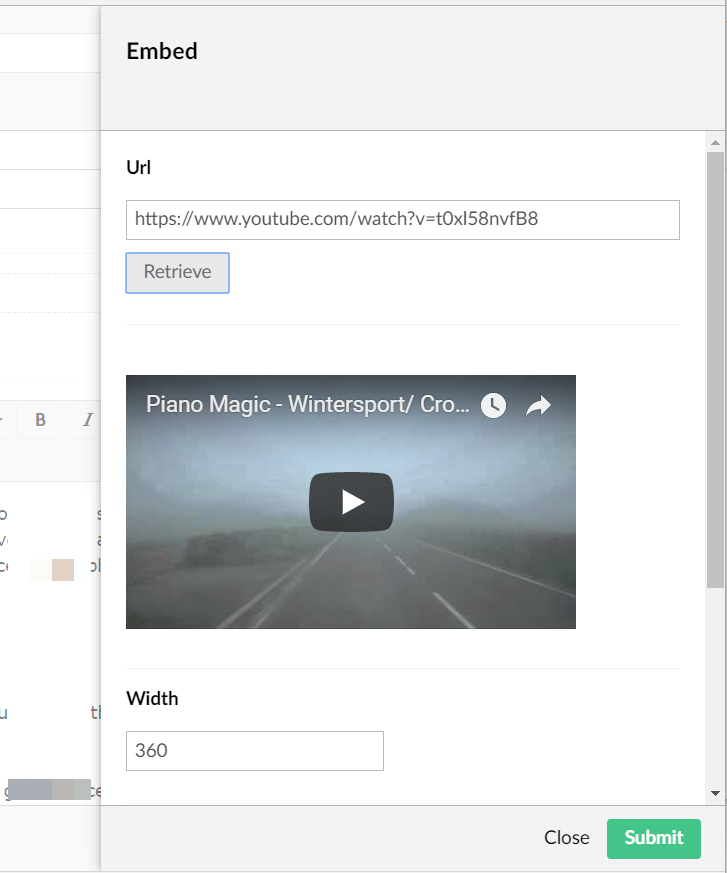
Information technology is the job of an 'Embed Provider', to accept the pasted Url, and to write out the advisable embed markup for the relevant tertiary party provider associated with the Url.
Embed Provider Configuration
Embed Providers are registered with the EmbedProvidersCollection during Composition when Umbraco boots.
The list of available default Embed Providers in an Umbraco install are as follows:
- YouTube
- Vimeo
- Dailymotion
- Flickr
- SlideShare
- Kickstarter
- Getty Images
- Ted
- SoundCloud
- Issuu
- Hulu
- Giphy
You can meet the details of these, and any recent editions in the C# programmer reference for Umbraco.Spider web.Media.EmbedProviders.
Configuring a new provider
Create a new provider by creating a C# class that implements the IEmbedProvider interface. Umbraco provides a convenient EmbedProviderBase class as a starting point.
namespace Umbraco.Cms.Core.Media.EmbedProviders { public abstract course EmbedProviderBase : IEmbedProvider { protected EmbedProviderBase(IJsonSerializer jsonSerializer); public abstruse string ApiEndpoint { get; } public abstruse string[] UrlSchemeRegex { get; } public abstract Dictionary<cord, cord> RequestParams { get; } public abstract cord GetMarkup(string url, int maxWidth = 0, int maxHeight = 0); public virtual string GetEmbedProviderUrl(cord url, int maxWidth, int maxHeight); public virtual string DownloadResponse(string url); public virtual T GetJsonResponse<T>(string url) where T : class; public virtual XmlDocument GetXmlResponse(string url); public virtual string GetXmlProperty(XmlDocument doc, cord holding); } } If the provider to add supports the OEmbed format for embedding a representation of a Url in a website, and then brand use of the EmbedProviderBase base methods to implement the asking:
public override string GetMarkup(cord url, int maxWidth = 0, int maxHeight = 0) { var requestUrl = base of operations.GetEmbedProviderUrl(url, maxWidth, maxHeight); var oembed = base.GetJsonResponse<OEmbedResponse>(requestUrl); return oembed.GetHtml(); } Adding a new OEmbed Provider Example
Let's let our editors to embed artwork from the popular DeviantArt website - the world's largest online social customs for artists and art enthusiasts. Nosotros can see they accept information on using OEmbed: https://world wide web.deviantart.com/developers/oembed. The format of their OEmbed implementation returns a JSON format, from a url https://backend.deviantart.com/oembed?url=[urltoembed]. We'll demand to apply the EmbedProviderBase and the base.GetJsonResponse method. We can see 'links' to media shared on DeviantArt are in the format: https://fav.me/[uniquemediaidentifier] so we'll need a regex to match any urls pasted into the embed panel that outset with fav.me, accomplished by setting the UrlSchemeRegex property.
The Provider would look like this:
using System.Collections.Generic; using Umbraco.Cms.Cadre.Media.EmbedProviders; using Umbraco.Cms.Core.Serialization; namespace MyNamespace { public class DeviantArtEmbedProvider : EmbedProviderBase { public DeviantArtEmbedProvider(IJsonSerializer jsonSerializer) : base(jsonSerializer) { } public override cord ApiEndpoint => "https://backend.deviantart.com/oembed?url="; public override string[] UrlSchemeRegex => new string[] { @"fav\.me/*", @"\w+\.deviantart.com\/\w+\/art\/*", @"\due west+\.deviantart.com\/art\/*", @"sta\.sh/*", @"\w+\.deviantart.com\/\due west+#\/d*", }; public override Dictionary<cord, string> RequestParams => new Dictionary<string, string>(); public override string GetMarkup(string url, int maxWidth = 0, int maxHeight = 0) { var requestUrl = base of operations.GetEmbedProviderUrl(url, maxWidth, maxHeight); var oembed = base.GetJsonResponse<OEmbedResponse>(requestUrl); return oembed.GetHtml(); } } } Register the provider with the OEmbedProvidersCollection
Create a new C# class that implements IUserComposer and add together append your new provider to the EmbedProvidersCollection:
using Umbraco.Cms.Core.Composing; using Umbraco.Cms.Cadre.DependencyInjection; namespace MyNamespace { public class RegisterEmbedProvidersComposer : IUserComposer { public void Compose(IUmbracoBuilder builder) => architect.OEmbedProviders().Append<DeviantArtEmbedProvider>(); } } The new provider should be available for editors to apply:
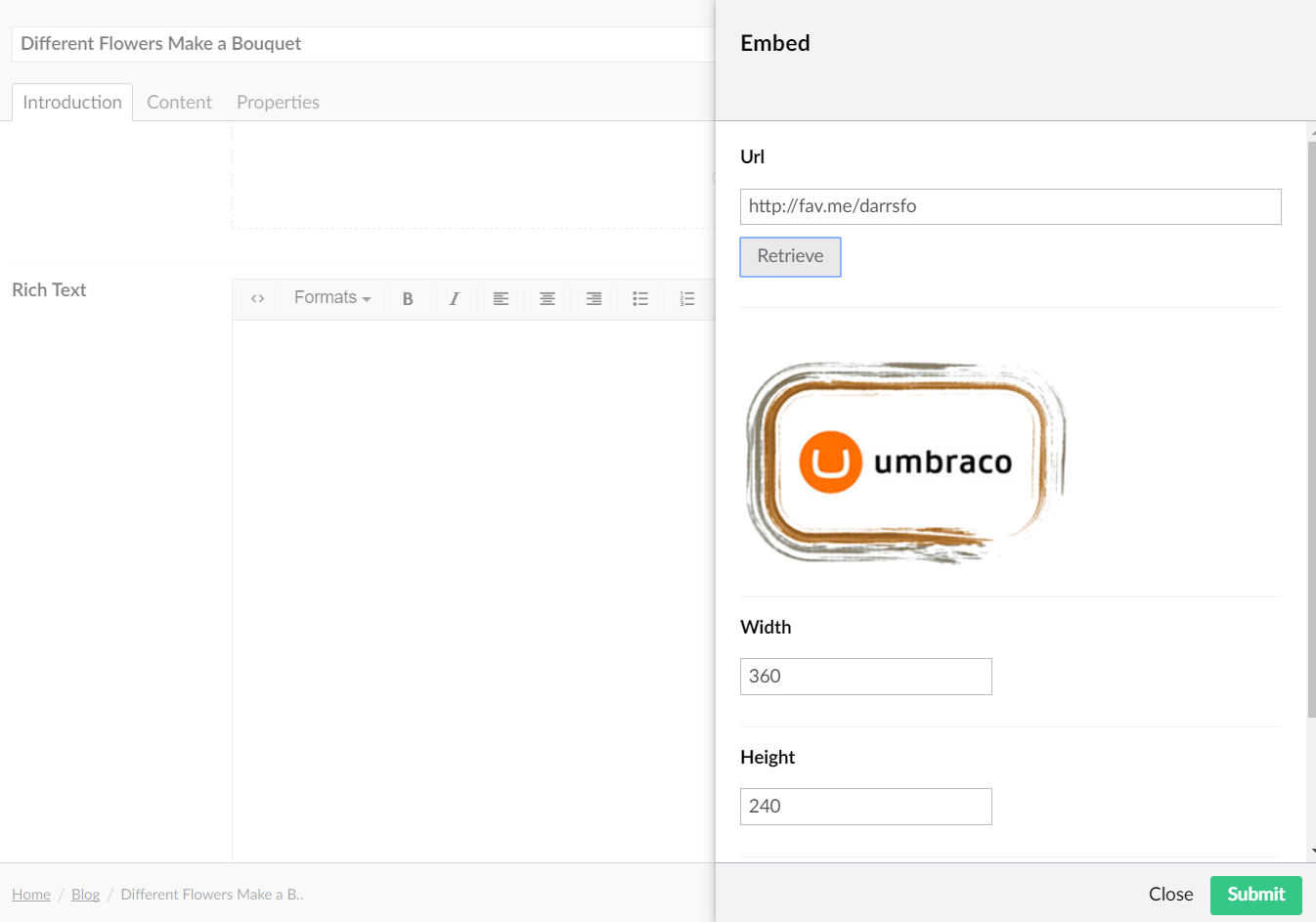
Discover there isn't really any implementation written here - the regex maps the incoming url to the provider, and the base methods handle the complexity of requesting from the third party api, and turning the response into html.
Custom Embed Providers
If your third-party media provider does not support OEmbed or there is some quirk with the content beingness embedded that requires custom html. so implement GetMarkup without using the base helper methods.
Custom Embed Provider Instance
Azure Media Services (https://azure.microsoft.com/en-gb/services/media-services/) provide 'circulate-quality' video streaming services. You lot can embed the Azure Media Role player into your site to play a video using an IFrame.
This example creates a custom Embed Provider to do the chore of taking the Url of the Media asset and writing out the markup required to embed the IFrame video player inside your content.
using System.Collections.Generic; using System.Cyberspace; using Umbraco.Cms.Cadre.Media.EmbedProviders; using Umbraco.Cms.Cadre.Serialization; namespace MyNamespace { public class AzureVideoEmbedProvider : EmbedProviderBase { public AzureVideoEmbedProvider(IJsonSerializer jsonSerializer) : base of operations(jsonSerializer) { } // no ApiEndpoint! public override string ApiEndpoint => string.Empty; public override cord[] UrlSchemeRegex => new string[] { @"windows\.net/*" }; public override Lexicon<cord, string> RequestParams => new Dictionary<string, string>(); public override string GetMarkup(string url, int maxWidth, int maxHeight) { // format of markup string videoFormat = "<div class=\"iplayer-container\"><iframe src=\"//aka.ms/ampembed?url={0}\" proper noun=\"azuremediaplayer\" scrolling=\"no\" frameborder=\"no\" align=\"heart\" autoplay=\"fake\" width=\"{1}\" meridian=\"{two}\" allowfullscreen></iframe></div>"; // pass in encoded Url, with and height, and turn off autoplay... var videoPlayerMarkup = string.Format(videoFormat, WebUtility.UrlEncode(url) + "&autoplay=simulated", maxWidth, maxHeight); return videoPlayerMarkup; } } } Here the markup to embed has been manually constructed based upon the iframe video player, no request to an Api endpoint is made...
Annals the Azure Embed Provider with the OEmbedProvidersCollection
Create a new C# class that implements IUserComposer and add append your new provider to the EmbedProvidersCollection:
using Umbraco.Cms.Core.Composing; using Umbraco.Cms.Core.DependencyInjection; namespace MyNamespace { public class RegisterEmbedProvidersComposer : IUserComposer { public void Etch(IUmbracoBuilder builder) => architect.OEmbedProviders().Append<AzureVideoEmbedProvider>(); } } Now editors can embed Azure Media video Urls in the format: //amssamples.streaming.mediaservices.windows.net/3b970ae0-39d5-44bd-b3a3-3136143d6435/AzureMediaServicesPromo.ism/manifest.
Source: https://our.umbraco.com/documentation/extending/Embedded-Media-Provider/
Posted by: robinsonlitaltalat.blogspot.com
0 Response to "How To Embed A Youtube Video Into Deviantart"
Post a Comment